
immune health: building resistance for september.
Every year it arrives at the same time. The children go back to school, and within a fortnight the whole town is coughing.
There's a pattern to it, and after ten years behind the counter we could set a calendar by it. The first week of September is quiet enough. The second week, someone comes in sounding hoarse. By the third, we're having the same conversation fifteen times a day.
What we’re noticing this Summer is that people are coming in before it starts. More of you are getting ahead of it, which is the sensible way round — the point of supporting your immune system is to do it while you're well, not to start scrambling on day three of a sore throat.
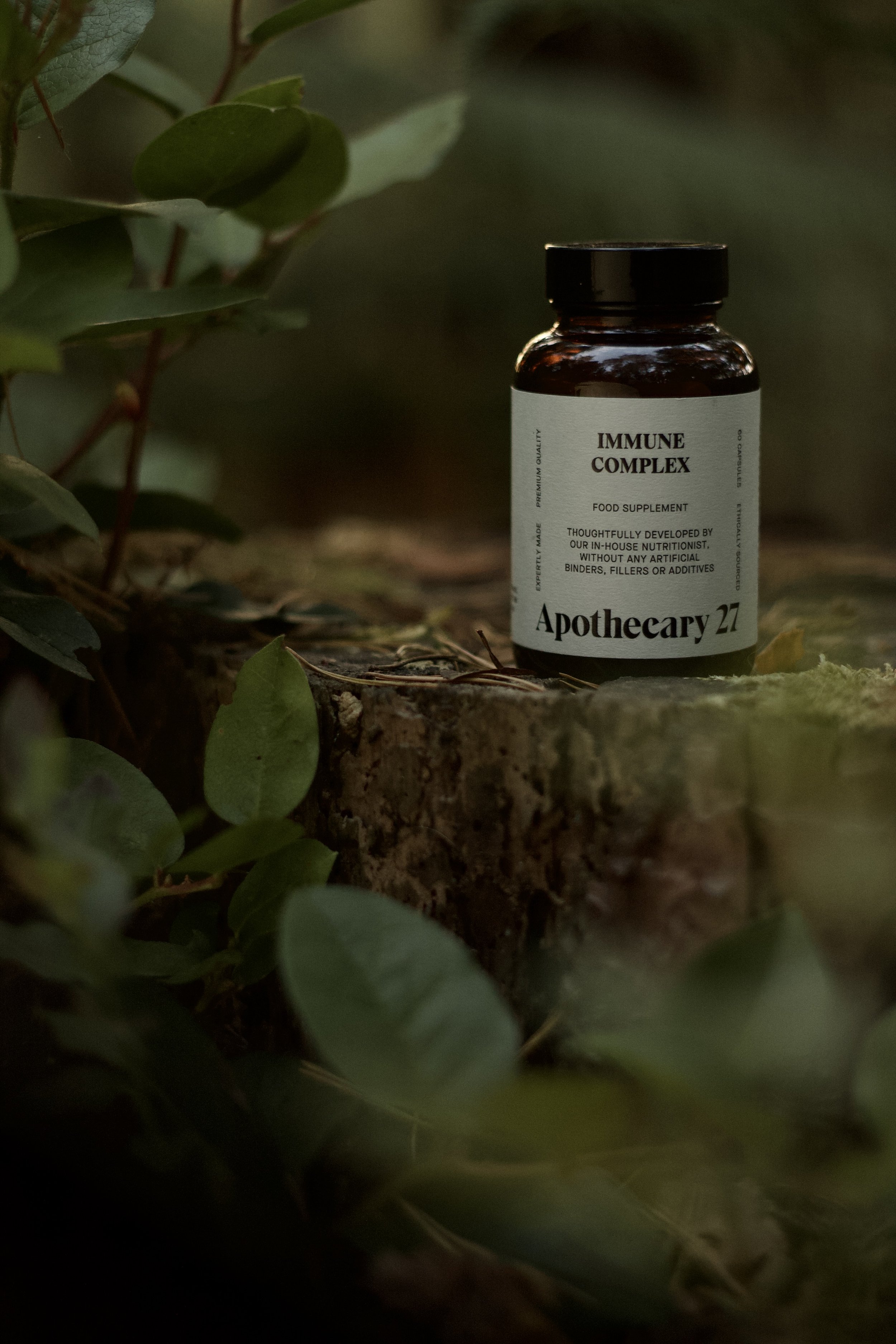
So this is the piece about the formula we built for exactly that.
WHY DID WE MAKE IT?
Every autumn we'd find ourselves recommending the same four or five things to the same people, who'd leave with four or five bottles. Or alternatively we’d hand over a bottle of of something which was packed with all the right things, but very small amounts of them.
Building the Immune Complex was mostly an exercise in leaving things out. There were a dozen ingredients we could have included. Most of them didn't make it — because putting fifteen botanicals in a capsule means each one ends up present in an amount too small to matter, and that's the trick a lot of this industry runs.
Eight made it in. Each one is there because one of us wouldn't let it go.
THE THREE OF US, AND WHAT WE insisted on

Joe: Olive Leaf. It's been my favourite for years and it's the one I take myself. Olea europaea has been part of Mediterranean life for thousands of years — the leaves as much as the fruit — and it's rich in oleuropein, the bitter compound the tree is known for. There's 260mg of extract in every two capsules, which is a real amount rather than a nod. If anything had to come out to make room, it wasn't going to be this.
Florence: Andrographis. Our in-store naturopath, and the one who knows the herbal literature best of any of us. Andrographis paniculata is a bitter herb with a long history in Ayurvedic practice, where it's been used for centuries. It isn't a household name in Britain, and Florence would tell you that's Britain's loss. 200mg per two capsules.
Carron: Garlic. Her answer to a surprising number of things, and she's rarely wrong. Garlic has been in the medicine cupboard of every culture that's ever grown it, and it's the ingredient people most reliably mean to eat more of and then don't. 300mg of extract, so you get it without anyone noticing at close range.
AND THE FIVE OTHERS
Zinc, as bisglycinate, at 10mg — a full 100% of the NRV. This is the one with the authorised science behind it: zinc contributes to the normal function of the immune system and to the protection of cells from oxidative stress. We use the bisglycinate form because it's well absorbed and easier on the stomach.
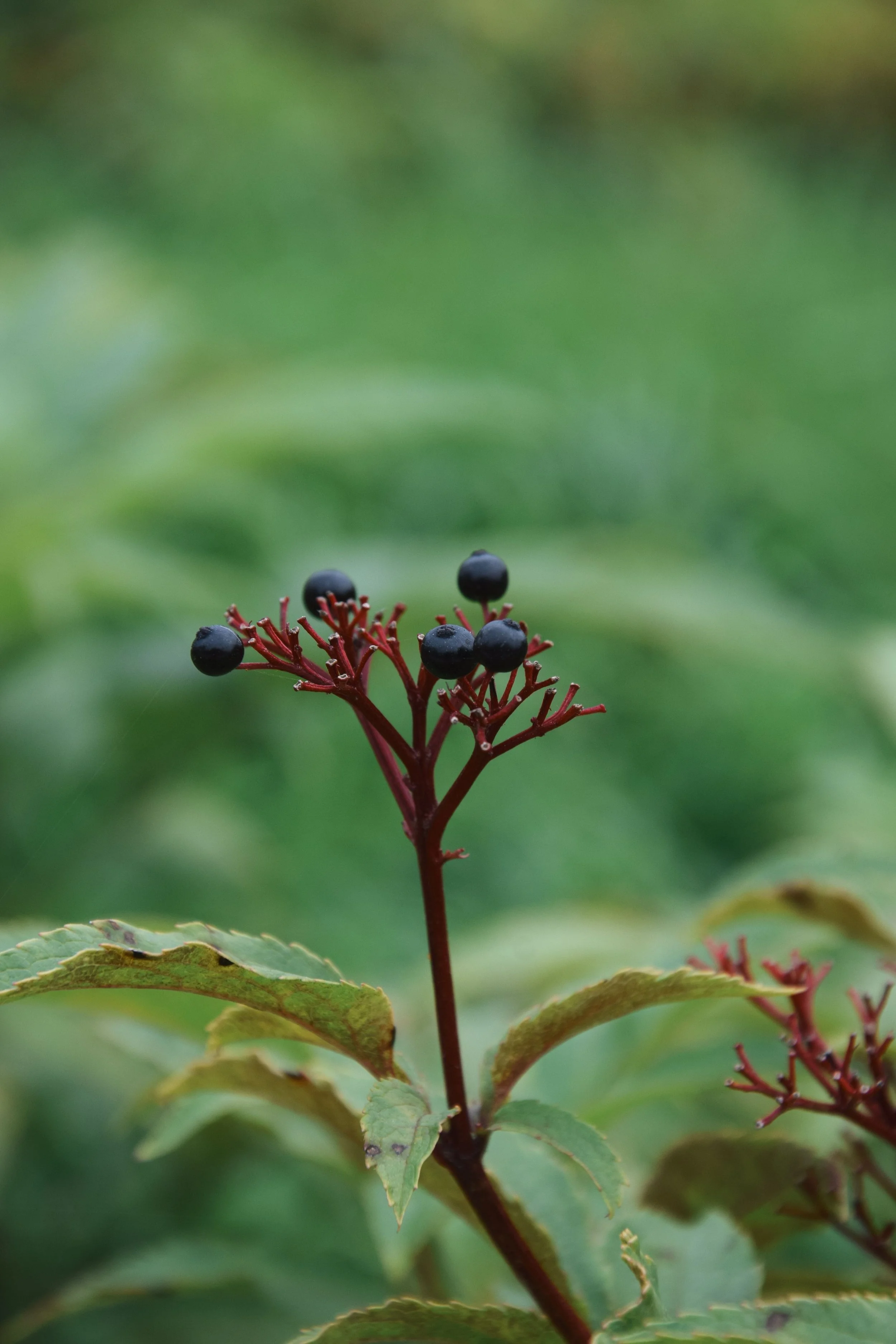
Elderberry, 300mg. The deep purple berry that hedgerow cordials have been made from for generations, rich in the anthocyanins that give it its colour.
Quercetin, 250mg, from Sophora japonica. A plant flavonoid that turns up alongside zinc in formulas for good reason - studies show it’s an excellent co-factor with zinc to enhance its absorption further.
Ginger, 40mg. Warming, and one of the oldest culinary and household herbs there is.
Manuka honey, 40mg. A small amount, but an ode to the kitchen-cupboard remedies that have always sat behind looking after yourself through a British winter.
HOW MANY SHOULD I TAKE?
Two capsules daily, through the season. That's the everyday dose, and the one we'd suggest from now through to March. Starting the habit in early September rather than mid-October is really the whole point of this piece.
Two capsules, up to three times daily, if you're already under the weather. That's the short-term dose — a few days, not a few weeks. At that level you're taking 30mg of zinc a day, which is above the amount advised for continuous use, so treat it as a spell rather than a routine (on those days where you can really feel something brewing).
WHAT DOES IT GO WITH?
Liposomal Vitamin C. This is the pairing we suggest most, and the two sit well side by side through the darker months. Vitamin C contributes to normal immune function and to the protection of cells from oxidative stress, and the liposomal form is absorbed more efficiently than standard ascorbic acid — which matters more than people realise, because ordinary vitamin C hits an absorption ceiling long before the number on the bottle suggests it should.
Vitamin D. Between October and March there isn't enough sunlight in Britain for most of us to make what we need, whatever we do outdoors. Vitamin D contributes to the normal function of the immune system, and it's the one the government itself suggests considering through the winter months.
Those three together are what a good number of our regulars end up taking from autumn onwards. Not because anyone sold them all three at once — but because it makes sense.
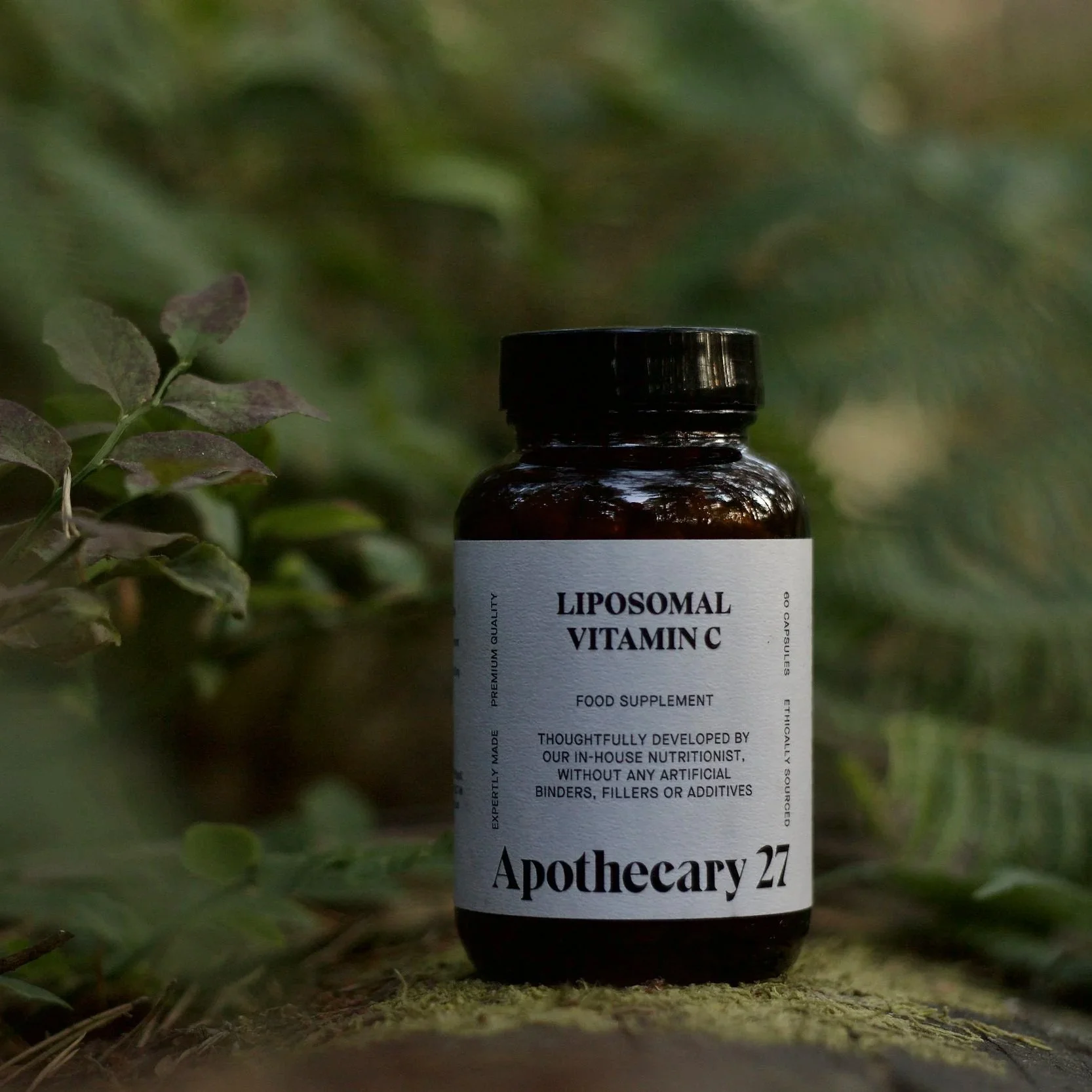
Vitamin C, upgraded. A liposomal form designed to be absorbed more efficiently than standard Vitamin C — at a meaningful 700mg per capsule.
Vitamin C is one of the few nutrients that earns its place at the centre of almost any routine. It contributes to normal immune function, to normal collagen formation for the normal function of skin, bones and cartilage, to the protection of cells from oxidative stress, and to the reduction of tiredness and fatigue — and it increases iron absorption. We can't make it ourselves and we can't store much, so getting it in — and getting it in well — matters.
The absorption question. Standard ascorbic acid works, but it has a ceiling: past a certain point the gut is saturated and the excess is passed out, which is why very high doses often give diminishing returns. Liposomal delivery takes a different route — each portion of Vitamin C is wrapped in microscopic lipid spheres that help carry the nutrient through digestion. We use PureWay-C®, a studied liposomal form, at a meaningful 700mg per capsule — a functional dose, not a token gesture.
Clean by design. A small amount of rice flour keeps the liposomal C from clumping, and a trace of bamboo-stem extract brings naturally occurring silica. Nothing artificial, nothing unnecessary — made the way everything here is made: meaningful doses, high absorption, always rooted in nature.
DIRECTIONS
Take one to two capsules daily, with food. Do not exceed the recommended dose unless directed by your healthcare practitioner.
SUPPLEMENT FACTS
Per capsule: PureWay-C® Liposomal Vitamin C — 700mg — 586.3% NRV
Ingredients: PureWay-C® Liposomal Vitamin C (700mg), Hydroxypropyl Methylcellulose Capsule (120mg), Rice Flour (Oryza sativa) (50mg, a natural addition to prevent Liposomal C from clumping), Silica from Bamboo Stem Extract (Bambusa vulgaris) (3.75mg).
60 capsules. Suitable for vegans. No artificial binders, fillers or additives.
QUESTIONS WE GET ASKED
What does liposomal actually mean?
The Vitamin C is encapsulated in microscopic lipid — fat — spheres. That protective layer helps it through the digestive system, so more of it is absorbed into the cells and it's retained longer. It's a delivery method rather than a different vitamin.
Is it better than ordinary Vitamin C?
It's better absorbed, which isn't quite the same as stronger. Ascorbic acid works perfectly well; the issue is how much you actually take up, particularly at higher doses. Liposomal delivery is a way round that ceiling.
Why 700mg rather than 1000mg?
Because absorption matters more than the number on the front. A well-absorbed 700mg does more than a poorly absorbed 1000mg. We'd rather be straight about that than compete on labels.
Should I take it with anything?
It pairs naturally with iron — Vitamin C increases iron absorption, so the two together make the iron work harder. A good many people take it alongside the Immune Complex through winter, too.
One capsule or two?
One daily is a considered dose for most people. Two through winter, or when you feel you need more. Whatever suits you.
Why is there rice flour in it?
Liposomal C clumps without something to keep it loose. Rice flour is the simplest natural way to do it — 50mg, and nothing artificial.
Is it suitable for vegans?
Yes. Plant-based capsule, no artificial binders, fillers or additives.
Food supplements should not be used as a substitute for a varied, balanced diet and a healthy lifestyle. Store in a cool, dry place, out of the reach of young children.
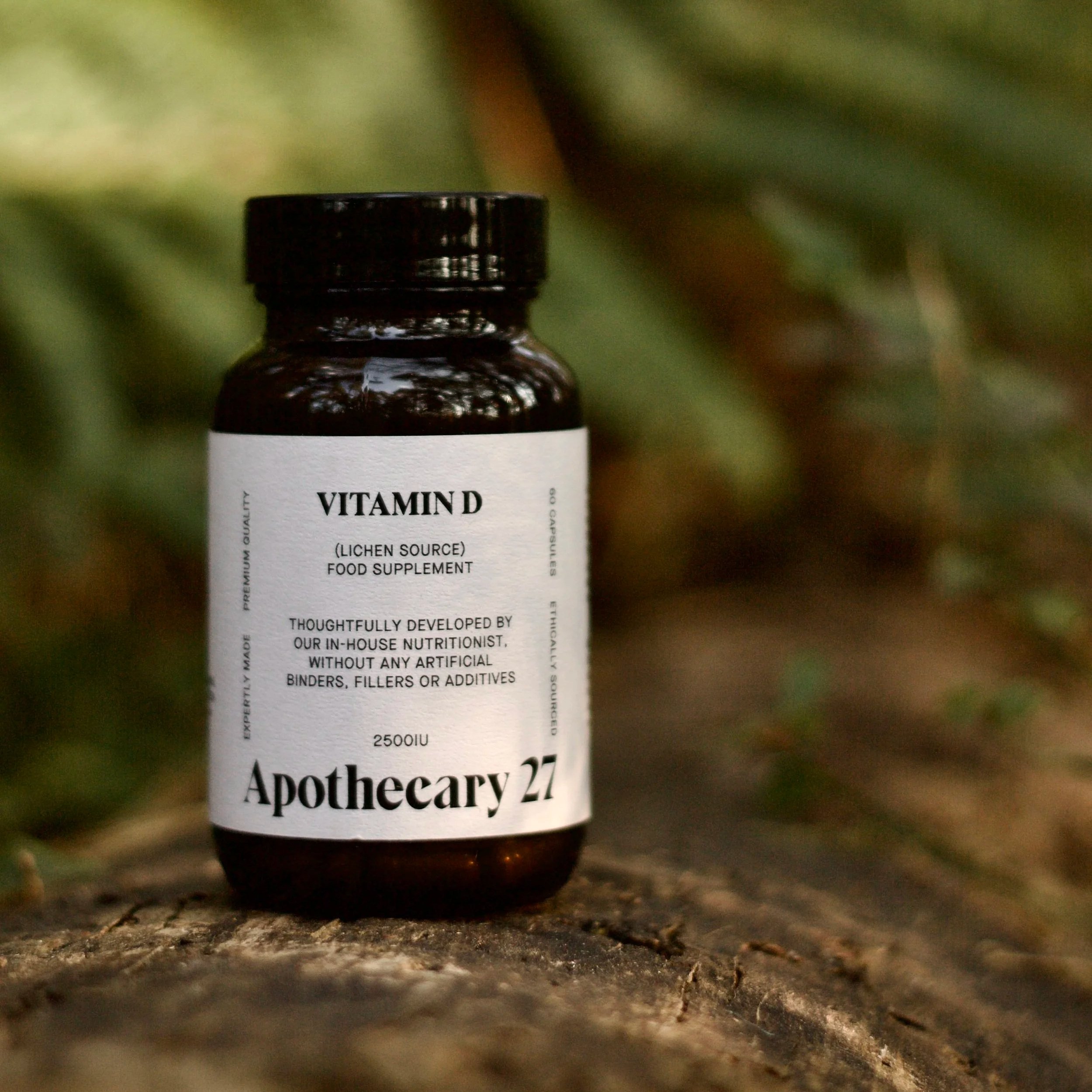
Sunshine in a bottle — at a dose that counts. 2500IU of vegan, lichen-derived D3, and nothing else. One capsule a day, especially through the darker months.
Vitamin D is one of the most recommended nutrients there is — and one of the most underdosed. Most of us in the UK run low through autumn and winter, when there's simply not enough sun on our skin to make our own. Vitamin D contributes to normal immune function, the maintenance of normal bones, teeth and muscle function, and normal absorption of calcium — which is why it matters most exactly when daylight is shortest.
A dose that does something. General guidance sits around 400IU a day, and most supplements stop there. For anyone who spends the darker half of the year mostly indoors, that's often not enough to make a real difference. Ours delivers 2500IU per capsule — a meaningful, research-grounded dose suitable for daily use by most healthy adults.
From lichen, not lanolin. Most D3 is extracted from lanolin — sheep's wool wax — which rules it out for vegans and gives others pause. Ours comes from lichen, one of the very few natural non-animal sources of D3, in a form that's highly absorbable and performs comparably to lanolin D3. Not a vegan compromise — a better-sourced D3 that happens to suit everyone.
In a simple base of alfalfa and a plant-based capsule, with nothing unnecessary added. Made the way everything here is made: meaningful doses, high absorption, always rooted in nature.
DIRECTIONS
Take one capsule daily, with food. Do not exceed the recommended dose unless directed by your healthcare practitioner.
SUPPLEMENT FACTS
Per capsule: Vitamin D3 (from lichen source) — 62.5µg (2500IU) — 1250% NRV
Ingredients: Vitamin D3 (from lichen source), in a base of Alfalfa (110mg), Hydroxypropyl Methylcellulose Capsule (40mg).
60 capsules. Suitable for vegans. No artificial binders, fillers or additives.
QUESTIONS WE GET ASKED
Is 2500IU a lot?
It's a considered dose. UK guidance suggests 400IU as a minimum through autumn and winter — enough to avoid deficiency, not necessarily enough to be comfortably sufficient. 2500IU sits well within the level regarded as safe for daily use by healthy adults, and it's where most people who take vitamin D seriously tend to land.
Why does the label say 1250% NRV when you're against big percentages?
The reference value for vitamin D was set decades ago and is very low, so any meaningful dose produces a large-looking number. Our objection is to doses far beyond what the body can hold onto — vitamin D isn't one of those. The percentage looks dramatic; the dose is sensible.
Why lichen rather than the usual D3?
Most vitamin D3 is made from lanolin, the wax in sheep's wool. Perfectly effective, but not vegan. Lichen — those unassuming organisms formed from a partnership between algae and fungi — is one of the few natural non-animal sources of true D3. The alternative, D2, isn't used by the body as well.
When should I take it?
One capsule daily with food. It's fat-soluble, so it's better absorbed alongside a meal containing some fat than on an empty stomach.
Do I need it all year?
Between roughly October and March, UK sunlight isn't strong enough for most of us to make what we need, however much time we spend outdoors — which is why the government suggests considering a supplement through those months. Plenty of people take it year-round, particularly if they're mostly indoors.
Is it suitable for vegans?
Yes. Lichen-sourced D3 in a plant-based capsule, with no binders, fillers or artificial anything.
Food supplements should not be used as a substitute for a varied, balanced diet and a healthy lifestyle. Store in a cool, dry place, out of the reach of young children.
A FEW THINGS WORTH KNOWING
It contains manuka honey, so it isn't suitable for vegans. It is suitable for vegetarians.
It isn't suitable during pregnancy or breastfeeding.
If you take blood-thinning medication, garlic at this level is worth a word with your GP or pharmacist before you start.
And if you're not sure whether it's the right thing for you, come and ask. That's what the counter is for — and if it needs more than a counter conversation, Florence sees people upstairs.