
“I’ve spent over twenty years in the health and wellness industry, watching beautifully packaged supplements fall short where it matters - under dosed, poorly absorbed, or both.
Apothecary 27 exists to change that. ”
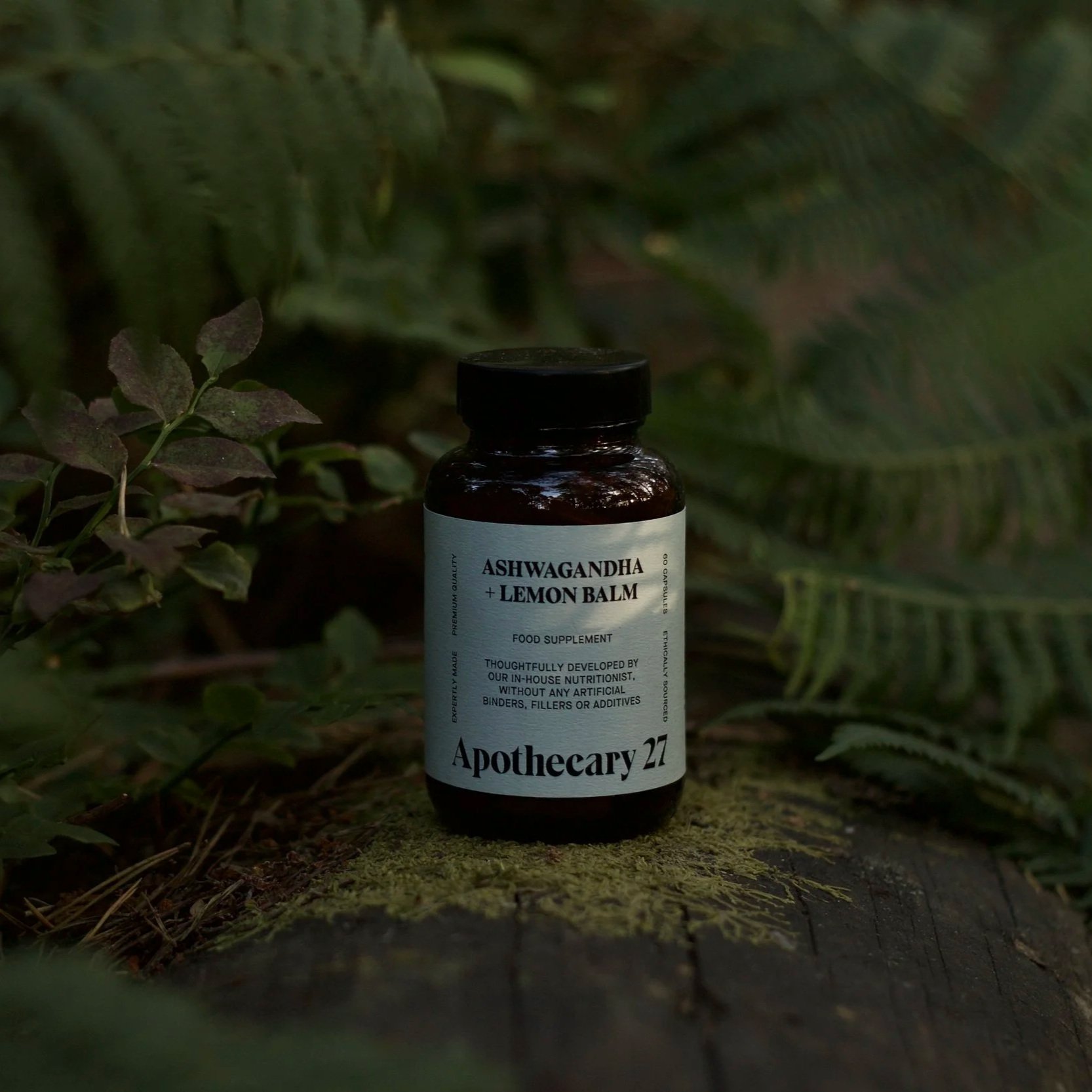
Two soothing herbs in one clean formula — the pairing our most zen customers return to. Organic ashwagandha and lemon balm, thoughtfully dosed, with nothing else added.
Ashwagandha and lemon balm are two of the herbs I've come back to most across my career — for their long heritage, their gentleness, and the quality of the plants themselves.
Ashwagandha (Withania somnifera) is one of the most revered botanicals in Ayurvedic tradition, where its root has been used for thousands of years. It belongs to a group of plants known as adaptogens — herbs that have long held a valued place in traditional wellbeing practices through life's busier, more demanding seasons. We use organic root, at a considered dose.
Lemon balm (Melissa officinalis) is a gentle member of the mint family, grown in apothecary and monastery gardens since antiquity — its name drawn from the Greek for honeybee. It has been cherished for generations as a calming garden and culinary herb, and sits naturally alongside ashwagandha.
Together they're the kind of considered pairing herbal tradition does best — two plants, each chosen for its heritage and quality, in a clean plant-based capsule with nothing else added. Made the way everything here is made: meaningful doses, high absorption, always rooted in nature.
DIRECTIONS
Take one to two capsules daily, with food. Do not exceed the recommended dose unless directed by your healthcare practitioner.
SUPPLEMENT FACTS
Per capsule:
Organic Ashwagandha Root (Withania somnifera) — 250mg
Organic Lemon Balm Leaf (Melissa officinalis) — 250mg
Ingredients: Organic Ashwagandha Root, Organic Lemon Balm Leaf, Hydroxypropyl Methylcellulose Capsule.
60 capsules. Certified organic by the Soil Association (GB-ORG-05). Suitable for vegans. No artificial binders, fillers or additives.
QUESTIONS WE GET ASKED
What does adaptogen actually mean?
It's a term for a group of plants — ashwagandha among them — that have long held a place in traditional herbal practice during busier, more demanding periods. It describes a category and a heritage rather than a guaranteed effect, and we'd rather be straight about that than overpromise.
One capsule or two?
One daily is a considered starting point. Some people prefer two. As with most herbs, giving it a few weeks matters more than the exact number.
Morning or evening?
Either. Many people take it in the evening, some in the morning; a few split it between the two. Whatever fits your day is the one you'll keep up.
Is the ashwagandha root or leaf?
Root, and organic. It's the part with the long traditional use behind it, and the part we'd want in a bottle with our name on it.
Is there anyone who shouldn't take it?
Ashwagandha isn't suitable during pregnancy or breastfeeding. If you take thyroid medication, sedatives, or medicines that affect the immune system, speak to your GP or pharmacist first. If you're unsure, ask us or book a consultation with Florence — it's the sort of thing worth a proper conversation.
Is it suitable for vegans?
Yes. Two organic herbs in a plant-based capsule, and nothing else.
Food supplements should not be used as a substitute for a varied, balanced diet and a healthy lifestyle. Store in a cool, dry place, out of the reach and sight of children.
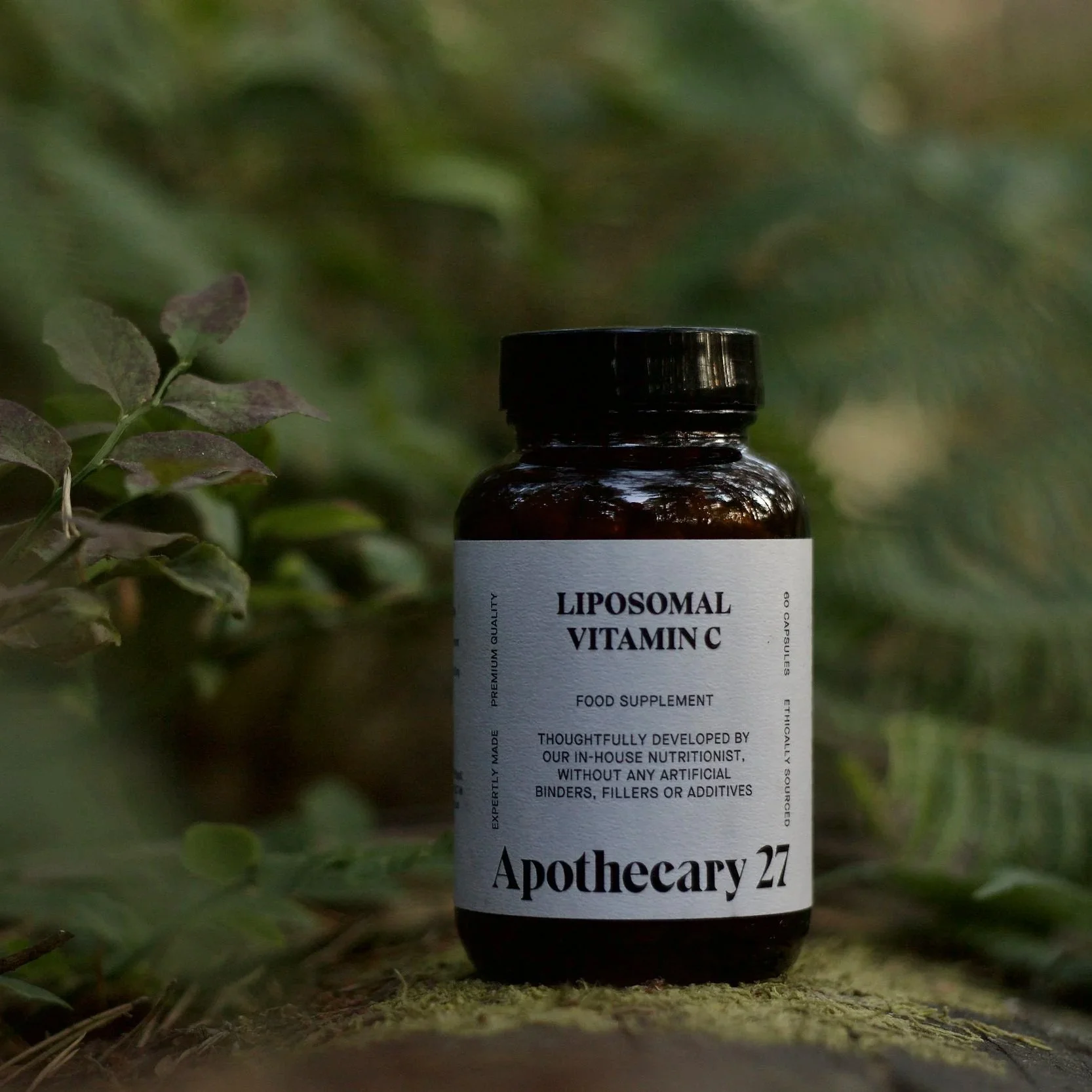
Vitamin C, upgraded. A liposomal form designed to be absorbed more efficiently than standard Vitamin C — at a meaningful 700mg per capsule.
Vitamin C is one of the few nutrients that earns its place at the centre of almost any routine. It contributes to normal immune function, to normal collagen formation for the normal function of skin, bones and cartilage, to the protection of cells from oxidative stress, and to the reduction of tiredness and fatigue — and it increases iron absorption. We can't make it ourselves and we can't store much, so getting it in — and getting it in well — matters.
The absorption question. Standard ascorbic acid works, but it has a ceiling: past a certain point the gut is saturated and the excess is passed out, which is why very high doses often give diminishing returns. Liposomal delivery takes a different route — each portion of Vitamin C is wrapped in microscopic lipid spheres that help carry the nutrient through digestion. We use PureWay-C®, a studied liposomal form, at a meaningful 700mg per capsule — a functional dose, not a token gesture.
Clean by design. A small amount of rice flour keeps the liposomal C from clumping, and a trace of bamboo-stem extract brings naturally occurring silica. Nothing artificial, nothing unnecessary — made the way everything here is made: meaningful doses, high absorption, always rooted in nature.
DIRECTIONS
Take one to two capsules daily, with food. Do not exceed the recommended dose unless directed by your healthcare practitioner.
SUPPLEMENT FACTS
Per capsule: PureWay-C® Liposomal Vitamin C — 700mg — 586.3% NRV
Ingredients: PureWay-C® Liposomal Vitamin C (700mg), Hydroxypropyl Methylcellulose Capsule (120mg), Rice Flour (Oryza sativa) (50mg, a natural addition to prevent Liposomal C from clumping), Silica from Bamboo Stem Extract (Bambusa vulgaris) (3.75mg).
60 capsules. Suitable for vegans. No artificial binders, fillers or additives.
QUESTIONS WE GET ASKED
What does liposomal actually mean?
The Vitamin C is encapsulated in microscopic lipid — fat — spheres. That protective layer helps it through the digestive system, so more of it is absorbed into the cells and it's retained longer. It's a delivery method rather than a different vitamin.
Is it better than ordinary Vitamin C?
It's better absorbed, which isn't quite the same as stronger. Ascorbic acid works perfectly well; the issue is how much you actually take up, particularly at higher doses. Liposomal delivery is a way round that ceiling.
Why 700mg rather than 1000mg?
Because absorption matters more than the number on the front. A well-absorbed 700mg does more than a poorly absorbed 1000mg. We'd rather be straight about that than compete on labels.
Should I take it with anything?
It pairs naturally with iron — Vitamin C increases iron absorption, so the two together make the iron work harder. A good many people take it alongside the Immune Complex through winter, too.
One capsule or two?
One daily is a considered dose for most people. Two through winter, or when you feel you need more. Whatever suits you.
Why is there rice flour in it?
Liposomal C clumps without something to keep it loose. Rice flour is the simplest natural way to do it — 50mg, and nothing artificial.
Is it suitable for vegans?
Yes. Plant-based capsule, no artificial binders, fillers or additives.
Food supplements should not be used as a substitute for a varied, balanced diet and a healthy lifestyle. Store in a cool, dry place, out of the reach of young children.
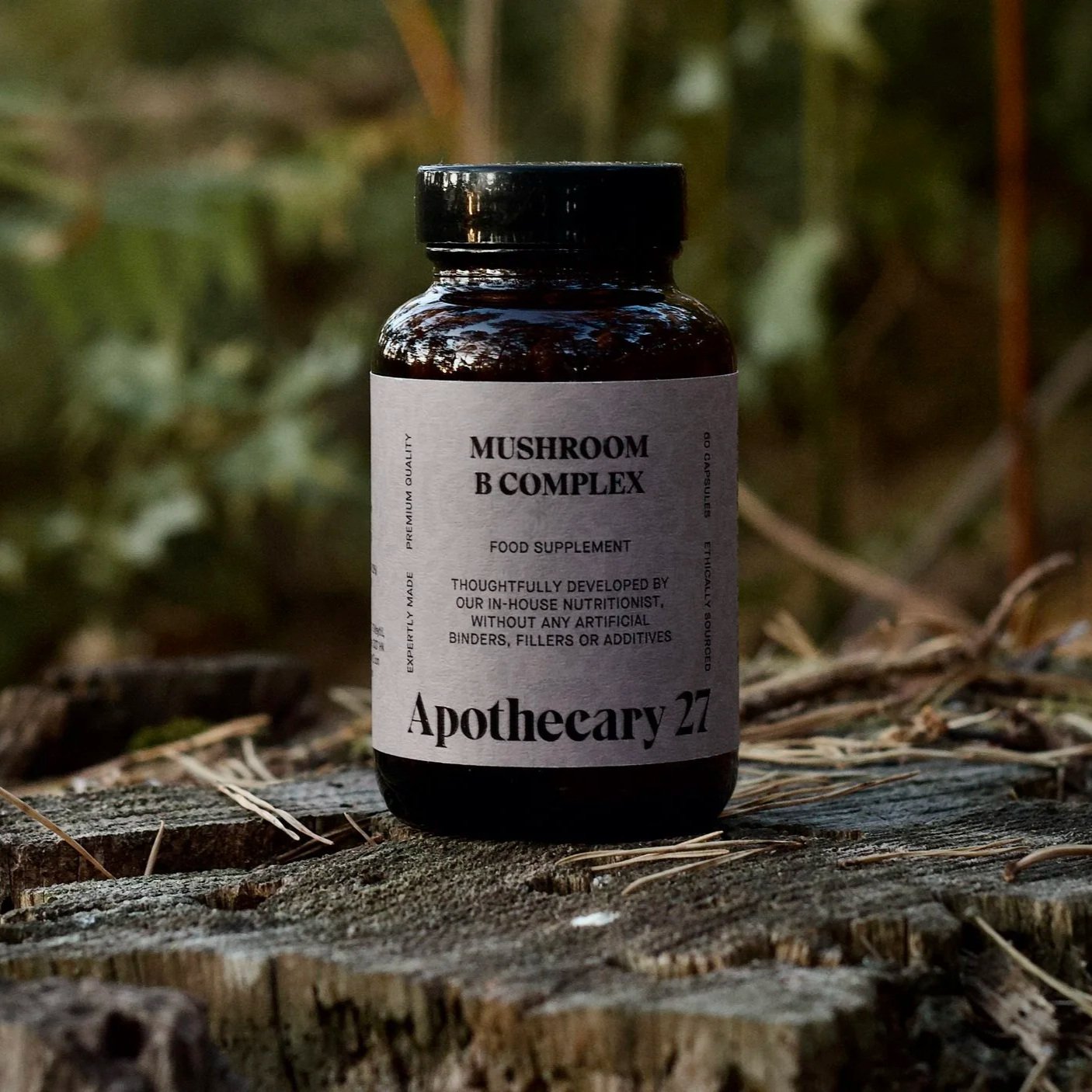
Our most talked-about formula. Active-form B vitamins at considered doses, with real amounts of Lion's Mane and Cordyceps.
Most B complexes are built on a single idea: more is more — B vitamins stacked at 5,000% or 10,000% of the NRV, far beyond what the body can hold onto. It looks impressive on a label, but most of the excess is simply passed straight out. We took a different view.
The B vitamins, done properly. We dose them at considered, meaningful levels — comfortably above the NRV, never extravagant — and choose their most active forms: B12 as methylcobalamin and B6 as P5P, ready for the body to use directly, without conversion. Across the spectrum, the B vitamins contribute to normal energy-yielding metabolism, the reduction of tiredness and fatigue, and normal psychological and nervous-system function — with folate playing its role in cell division and B12 and B6 in normal red blood cell formation.
Room for two remarkable mushrooms. Choosing sensible B-vitamin doses freed real space for Lion's Mane and Cordyceps, each at a full 300mg. We use the same certified organic mushrooms that go into our standalone Lion's Mane — though because this formula also contains B vitamins, the finished product itself can't be labelled organic. Here they're co-stars, not token additions, chosen with the same rigour as everything else in the bottle.
The result is a B complex made the way we think it should be: meaningful doses, high absorption, always rooted in nature.
DIRECTIONS
Take one capsule daily, with food. Do not exceed the recommended dose unless directed by your healthcare practitioner.
SUPPLEMENT FACTS
Per capsule:
Lion's Mane (Hericium erinaceus) — 300mg
Cordyceps (Ophiocordyceps sinensis) — 300mg
Vitamin B3 (as niacinamide) — 35mg — 218% NRV
Vitamin B6 (as pyridoxal 5'-phosphate) — 10mg — 714% NRV
Vitamin B1 (as thiamine HCl) — 10mg — 909% NRV
Vitamin B5 (as calcium pantothenate) — 10mg — 166% NRV
Vitamin B2 (riboflavin) — 10mg — 714% NRV
Biotin — 500µg — 1000% NRV
Folic Acid — 500µg — 250% NRV
Vitamin B12 (as methylcobalamin) — 200µg — 8000% NRV
Ingredients: Lion's Mane, Cordyceps, Hydroxypropyl Methylcellulose Capsule, Niacinamide, Pyridoxal 5'-phosphate, Thiamine HCl, Calcium Pantothenate, Riboflavin, Biotin, Folic Acid, Methylcobalamin.
60 capsules. Suitable for vegans. No artificial binders, fillers or additives.
QUESTIONS WE GET ASKED
How many should I take?
One capsule daily, with food. That's the dose it's built around — there's no need for more.
Are the mushrooms organic?
The mushrooms themselves are certified organic — the same ones we use in our standalone Lion's Mane. The finished capsule can't carry the organic mark, because the B vitamins in it aren't organic and certification applies to the whole product rather than to individual ingredients. Our Organic Lion's Mane is certified, if that matters to you.
Why do some of the percentages look high when you're against inflated doses?
Because the reference values for several B vitamins are very low, so any useful amount produces a large number. Our objection is to formulas built at 5,000 or 10,000% for the sake of the label. These are considered doses that happen to look dramatic against an old benchmark — and we've used the space we saved for a real amount of mushroom instead.
What are P5P and methylcobalamin?
The active forms of B6 and B12 — the shapes the body can use directly, without having to convert them first. They cost more than the standard forms, which is why most complexes don't use them.
Morning or evening?
Most people take it in the morning with breakfast. B vitamins are water-soluble, so a consistent daily habit matters more than the hour.
Will it turn my urine bright yellow?
Almost certainly, and it's nothing to worry about. Riboflavin is a strong yellow pigment and the excess is passed out. It's a sign the B2 is in there, not that anything's wrong.
Should I take it with anything?
It sits well alongside our Iron Complex if you're vegan or vegetarian. If you want more of the mushroom without more B vitamins, our standalone Organic Lion's Mane is the one.
Is it suitable for vegans?
Yes. Plant-based capsule, no binders, fillers or artificial anything.
Food supplements should not be used as a substitute for a varied, balanced diet and a healthy lifestyle. Store in a cool, dry place, out of the reach and sight of children.
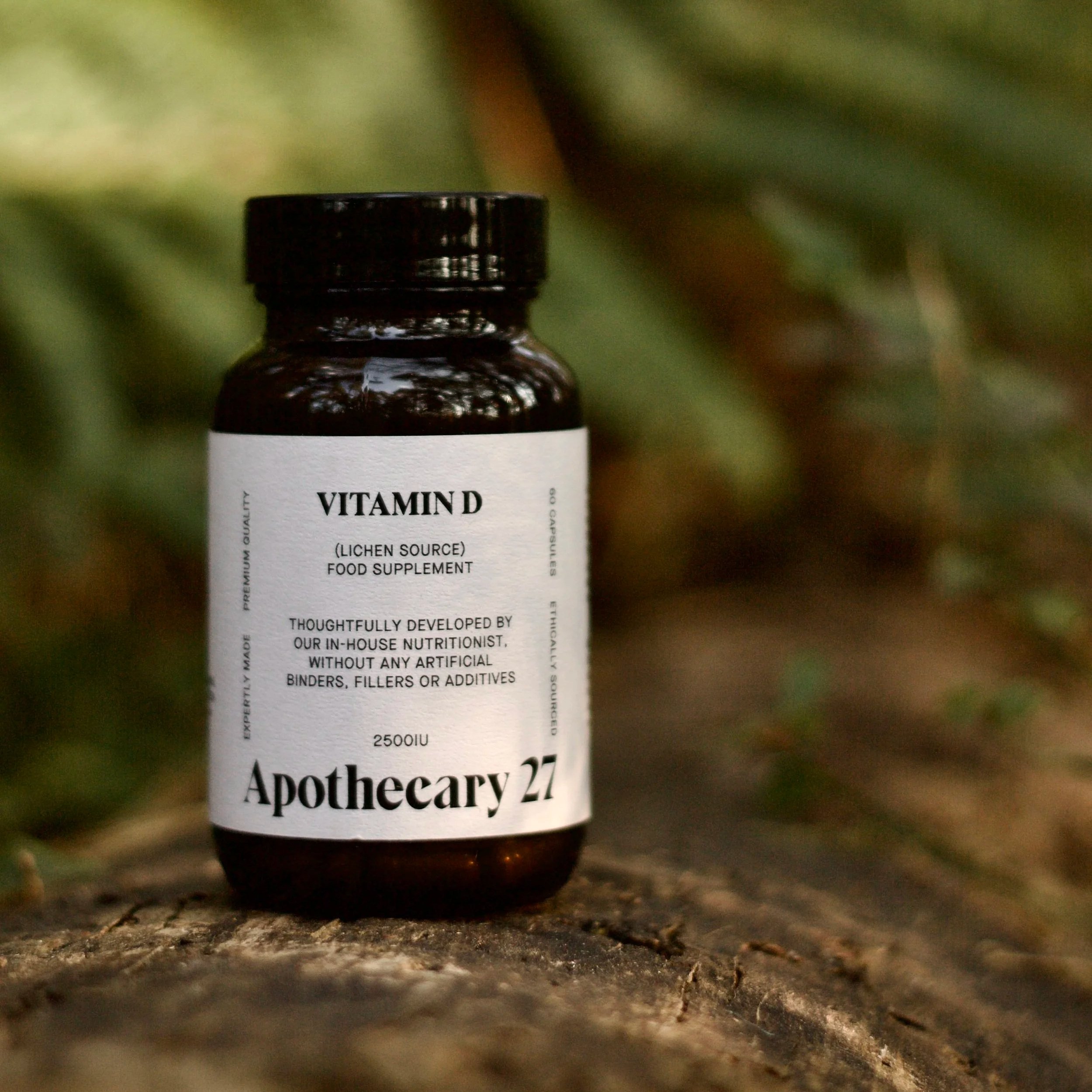
Sunshine in a bottle — at a dose that counts. 2500IU of vegan, lichen-derived D3, and nothing else. One capsule a day, especially through the darker months.
Vitamin D is one of the most recommended nutrients there is — and one of the most underdosed. Most of us in the UK run low through autumn and winter, when there's simply not enough sun on our skin to make our own. Vitamin D contributes to normal immune function, the maintenance of normal bones, teeth and muscle function, and normal absorption of calcium — which is why it matters most exactly when daylight is shortest.
A dose that does something. General guidance sits around 400IU a day, and most supplements stop there. For anyone who spends the darker half of the year mostly indoors, that's often not enough to make a real difference. Ours delivers 2500IU per capsule — a meaningful, research-grounded dose suitable for daily use by most healthy adults.
From lichen, not lanolin. Most D3 is extracted from lanolin — sheep's wool wax — which rules it out for vegans and gives others pause. Ours comes from lichen, one of the very few natural non-animal sources of D3, in a form that's highly absorbable and performs comparably to lanolin D3. Not a vegan compromise — a better-sourced D3 that happens to suit everyone.
In a simple base of alfalfa and a plant-based capsule, with nothing unnecessary added. Made the way everything here is made: meaningful doses, high absorption, always rooted in nature.
DIRECTIONS
Take one capsule daily, with food. Do not exceed the recommended dose unless directed by your healthcare practitioner.
SUPPLEMENT FACTS
Per capsule: Vitamin D3 (from lichen source) — 62.5µg (2500IU) — 1250% NRV
Ingredients: Vitamin D3 (from lichen source), in a base of Alfalfa (110mg), Hydroxypropyl Methylcellulose Capsule (40mg).
60 capsules. Suitable for vegans. No artificial binders, fillers or additives.
QUESTIONS WE GET ASKED
Is 2500IU a lot?
It's a considered dose. UK guidance suggests 400IU as a minimum through autumn and winter — enough to avoid deficiency, not necessarily enough to be comfortably sufficient. 2500IU sits well within the level regarded as safe for daily use by healthy adults, and it's where most people who take vitamin D seriously tend to land.
Why does the label say 1250% NRV when you're against big percentages?
The reference value for vitamin D was set decades ago and is very low, so any meaningful dose produces a large-looking number. Our objection is to doses far beyond what the body can hold onto — vitamin D isn't one of those. The percentage looks dramatic; the dose is sensible.
Why lichen rather than the usual D3?
Most vitamin D3 is made from lanolin, the wax in sheep's wool. Perfectly effective, but not vegan. Lichen — those unassuming organisms formed from a partnership between algae and fungi — is one of the few natural non-animal sources of true D3. The alternative, D2, isn't used by the body as well.
When should I take it?
One capsule daily with food. It's fat-soluble, so it's better absorbed alongside a meal containing some fat than on an empty stomach.
Do I need it all year?
Between roughly October and March, UK sunlight isn't strong enough for most of us to make what we need, however much time we spend outdoors — which is why the government suggests considering a supplement through those months. Plenty of people take it year-round, particularly if they're mostly indoors.
Is it suitable for vegans?
Yes. Lichen-sourced D3 in a plant-based capsule, with no binders, fillers or artificial anything.
Food supplements should not be used as a substitute for a varied, balanced diet and a healthy lifestyle. Store in a cool, dry place, out of the reach of young children.
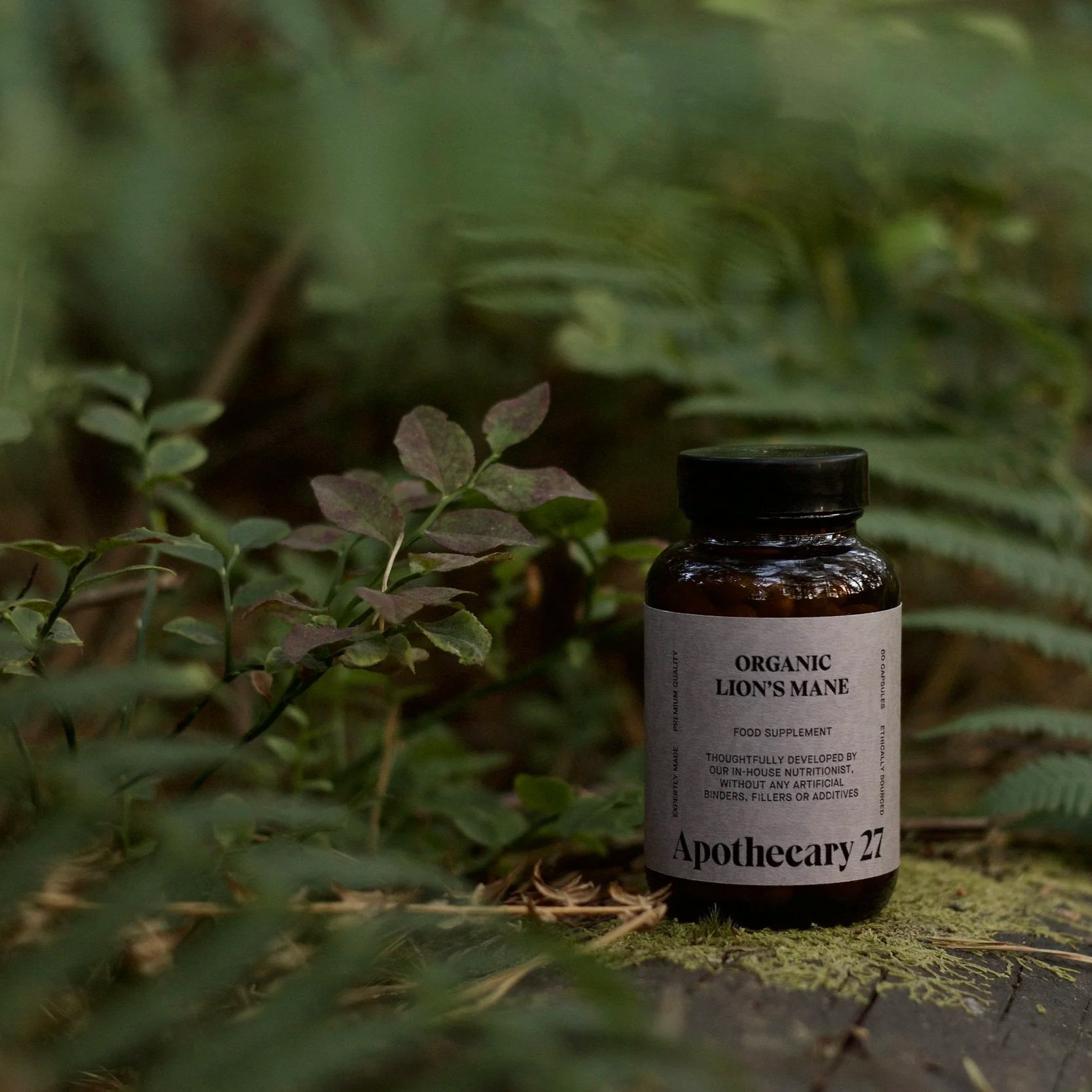
The most popular mushroom in the forest — organically grown, fruiting body only, nothing else inside.
Lion's Mane is one of the most talked-about mushrooms in natural health, and one of the most distinctive things you'll ever see growing on a tree. Its unmistakable cascading white spines have earned it a run of names over the years — monkey head, bearded tooth, pom-pom mushroom — and it's as striking to look at as it is sought after.
Fruiting body only — the actual mushroom. This is where quality is made or lost. Many Lion's Mane supplements are grown as mycelium on grain: quicker and cheaper, but the finished powder carries a large amount of starch from the grain and far less of the mushroom itself. Ours uses only the fruiting body — the true mushroom — organically and sustainably grown, where its natural compounds are most concentrated.
A meaningful amount, and nothing else. 700mg of organic fruiting-body Lion's Mane per capsule, in a clean plant-based capsule with no fillers, binders or additives of any kind.
Made the way everything here is made: meaningful doses, high absorption, always rooted in nature.
DIRECTIONS
Take two capsules daily, with food. Do not exceed the recommended dose unless directed by your healthcare practitioner.
SUPPLEMENT FACTS
Per capsule: Organic Lion's Mane (Hericium erinaceus), fruiting body — 700mg
Ingredients: Organic Lion's Mane Fruiting Body, Hydroxypropyl Methylcellulose Capsule.
60 capsules. Certified organic by the Soil Association (GB-ORG-05). Suitable for vegans. No artificial binders, fillers or additives.
QUESTIONS WE GET ASKED
What's the difference between fruiting body and mycelium?
The fruiting body is the mushroom itself — the part you'd recognise growing on a tree. Mycelium is the root-like network beneath, and it's usually grown on grain, which stays in the finished powder as starch. A mycelium product can be mostly grain by weight. Ours is fruiting body only, which is why we say so on the front.
How can I tell what I'm buying elsewhere?
Look for the words fruiting body. If a label says mycelium, mycelial biomass, or simply doesn't specify, it's usually grain-grown. Beta-glucan content is the other tell — some brands publish it, most don't.
How many should I take?
Two capsules daily with food — 1400mg. Mushrooms tend to be a slow build rather than an immediate thing, so give it a few weeks of consistency.
Is this the same mushroom as in your Mushroom B Complex?
Yes, the same organic fruiting body. The B Complex carries 300mg alongside its B vitamins; this one is 700mg per capsule and nothing else. If you want the mushroom on its own, or more of it, this is the one.
Is it certified organic?
Yes — certified by the Soil Association, GB-ORG-05. Single ingredient, so nothing complicates it.
Is it suitable for vegans?
Yes. One organic mushroom in a plant-based capsule, and nothing else.
Food supplements should not be used as a substitute for a varied, balanced diet and a healthy lifestyle. Store in a cool, dry place, out of the reach and sight of children.
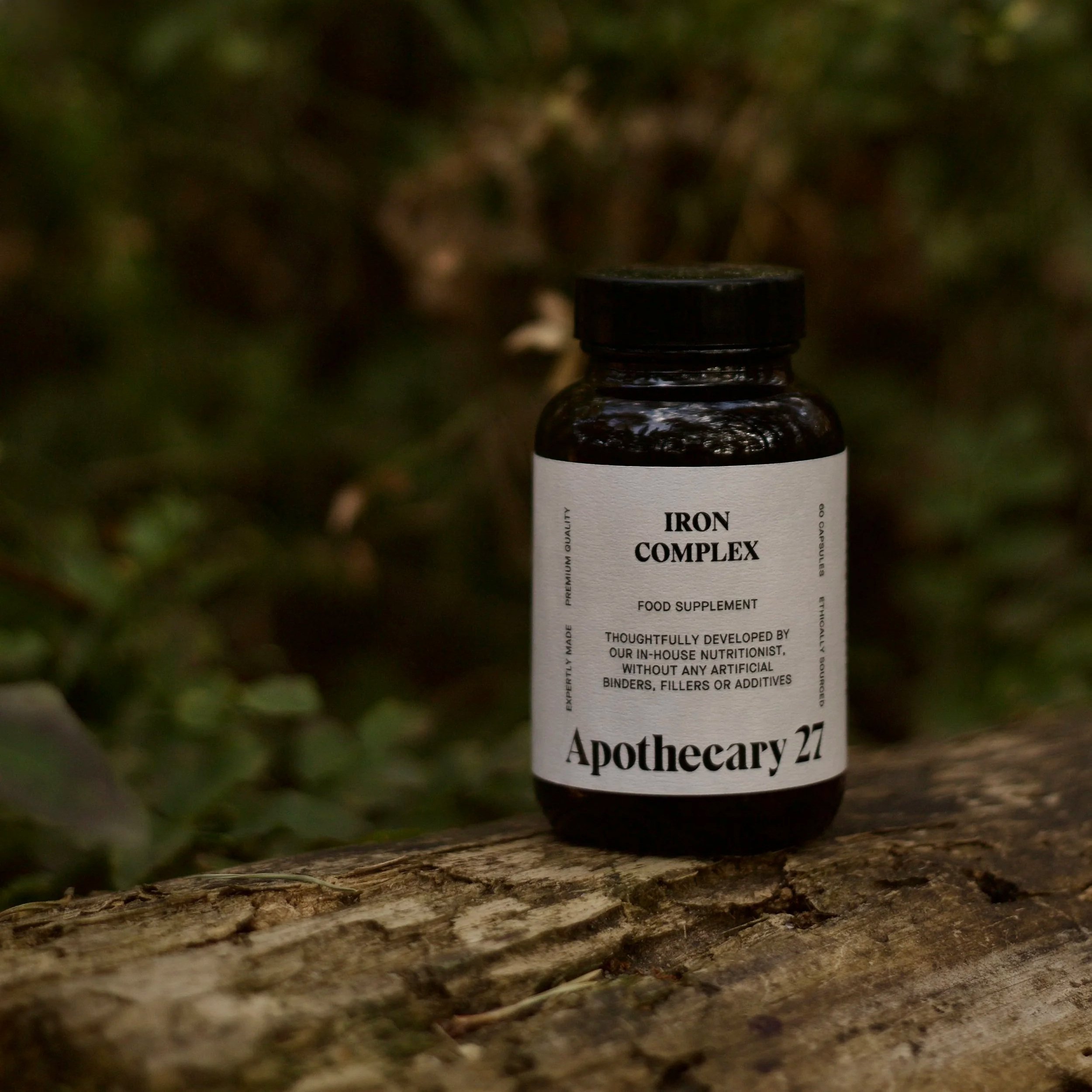
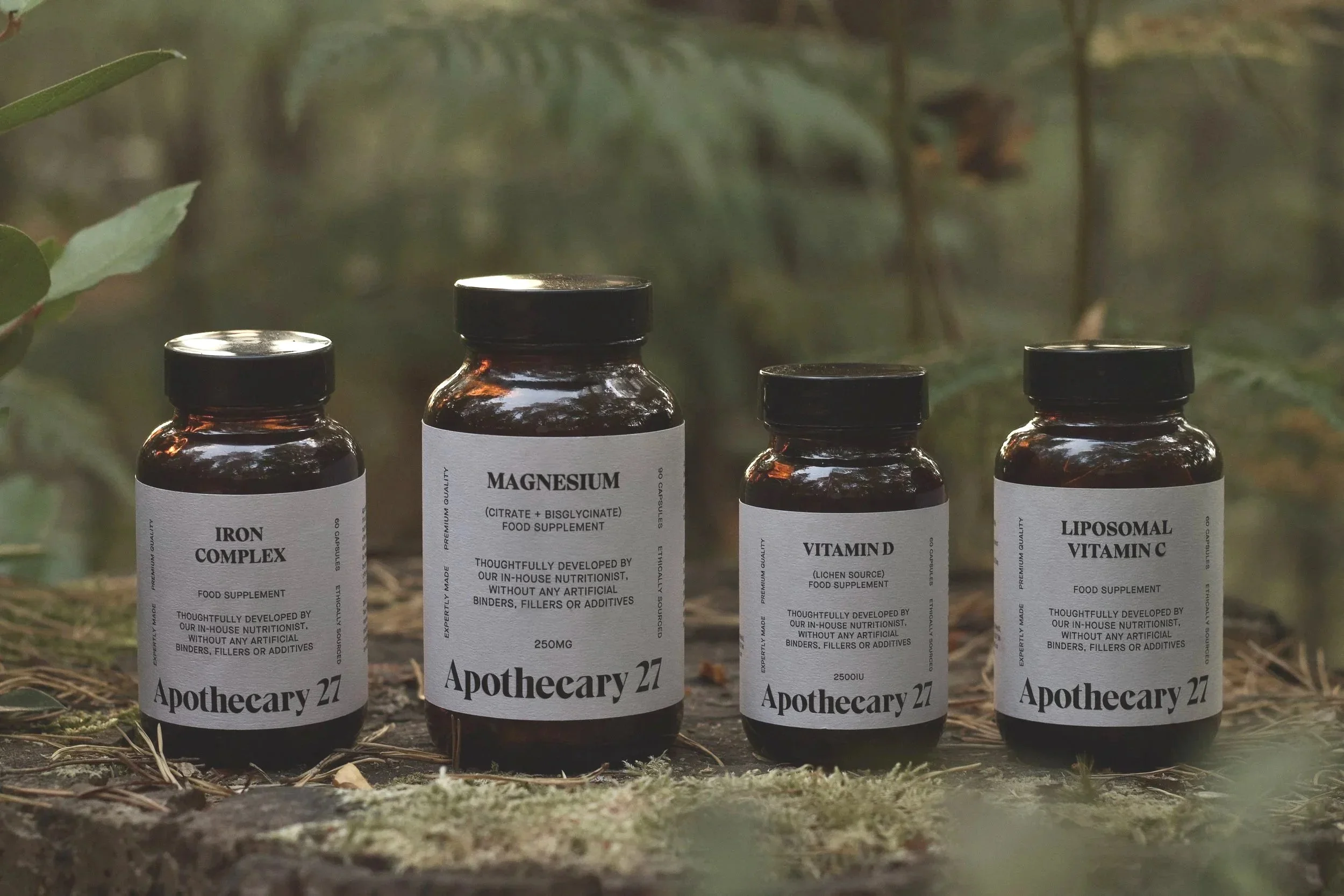
The gentle iron. Highly absorbable bisglycinate, paired with Vitamin C and B12 — formulated for people who've struggled with iron before.
Iron is one of the most common things people run low on — and iron supplements have a reputation, often deserved, for being hard on the stomach. For a lot of people the discomfort is enough to give up on iron altogether, which rather defeats the point. Our Iron Complex was built to solve both halves of that problem at once.
A gentler, more absorbable form. Most iron supplements use cheap iron salts — ferrous sulphate or fumarate — that are notoriously tough on digestion. We use iron bisglycinate: iron bound to the amino acid glycine, highly bioavailable and far kinder on the gut. It's the form I reach for first with anyone who's struggled with standard iron before. Iron contributes to normal formation of red blood cells and haemoglobin, normal oxygen transport, and the reduction of tiredness and fatigue.
Supporting nutrients that earn their place. Vitamin C is here because it increases iron absorption. Magnesium contributes to normal muscle function and to the reduction of tiredness and fatigue. And Vitamin B12, as methylcobalamin — the active form the body uses directly — completes the red-blood-cell and energy picture that iron alone can't, which makes it a thoughtful inclusion for vegans, vegetarians and anyone watching their B12.
One capsule daily, a two-month supply, made the way everything here is made: meaningful doses, high absorption, always rooted in nature.
DIRECTIONS
Take one capsule daily, with food. Do not exceed the recommended dose unless directed by your healthcare practitioner.
SUPPLEMENT FACTS
Per capsule:
Iron (as iron bisglycinate) — 30mg — 214% NRV
Magnesium (as magnesium citrate) — 42mg — 11% NRV
Vitamin C (as ascorbic acid) — 42mg — 52% NRV
Vitamin B12 (as methylcobalamin) — 100µg — 4000% NRV
Ingredients: Magnesium Citrate, Iron Bisglycinate, Hydroxypropyl Methylcellulose Capsule, Vitamin C (Ascorbic Acid), Vitamin B12 (Methylcobalamin).
60 capsules. Suitable for vegans. No artificial binders, fillers or additives.
QUESTIONS WE GET ASKED
Will this upset my stomach like other iron has?
That's precisely what it was built to avoid. Most of the trouble comes from cheap iron salts — ferrous sulphate in particular. Bisglycinate is iron bound to an amino acid, which makes it both well absorbed and considerably gentler. It's the first thing we suggest to anyone who's given up on iron before.
Is 30mg a lot of iron?
It's a proper dose rather than a token one, and higher than a general multivitamin would carry. If you're taking iron because you know you need it, that's the point. If you're not sure whether you need it, iron is genuinely one to ask about first — a blood test tells you, and taking iron you don't need isn't advisable. Ask us, book a consultation, or speak to your GP.
Why is the B12 at 4000% NRV?
Because B12 is poorly absorbed by design — the body takes up only a small fraction of an oral dose, so meaningful supplemental B12 always produces a large-looking percentage. The reference value is also very low. It's a different situation from a B vitamin stacked high for the sake of the label.
Should I take it with anything?
Vitamin C increases iron absorption, and there's already some in each capsule. Our Liposomal Vitamin C alongside it takes that further. Worth knowing that tea and coffee reduce iron absorption, so a gap either side of your capsule helps.
When should I take it?
One capsule daily with food. Consistency matters more than timing.
Is it suitable for vegans?
Yes — and the B12 makes it a sensible choice for anyone eating plant-based, since low iron and low B12 often travel together.
Food supplements should not be used as a substitute for a varied, balanced diet and a healthy lifestyle. Store in a cool, dry place, out of the reach and sight of children.
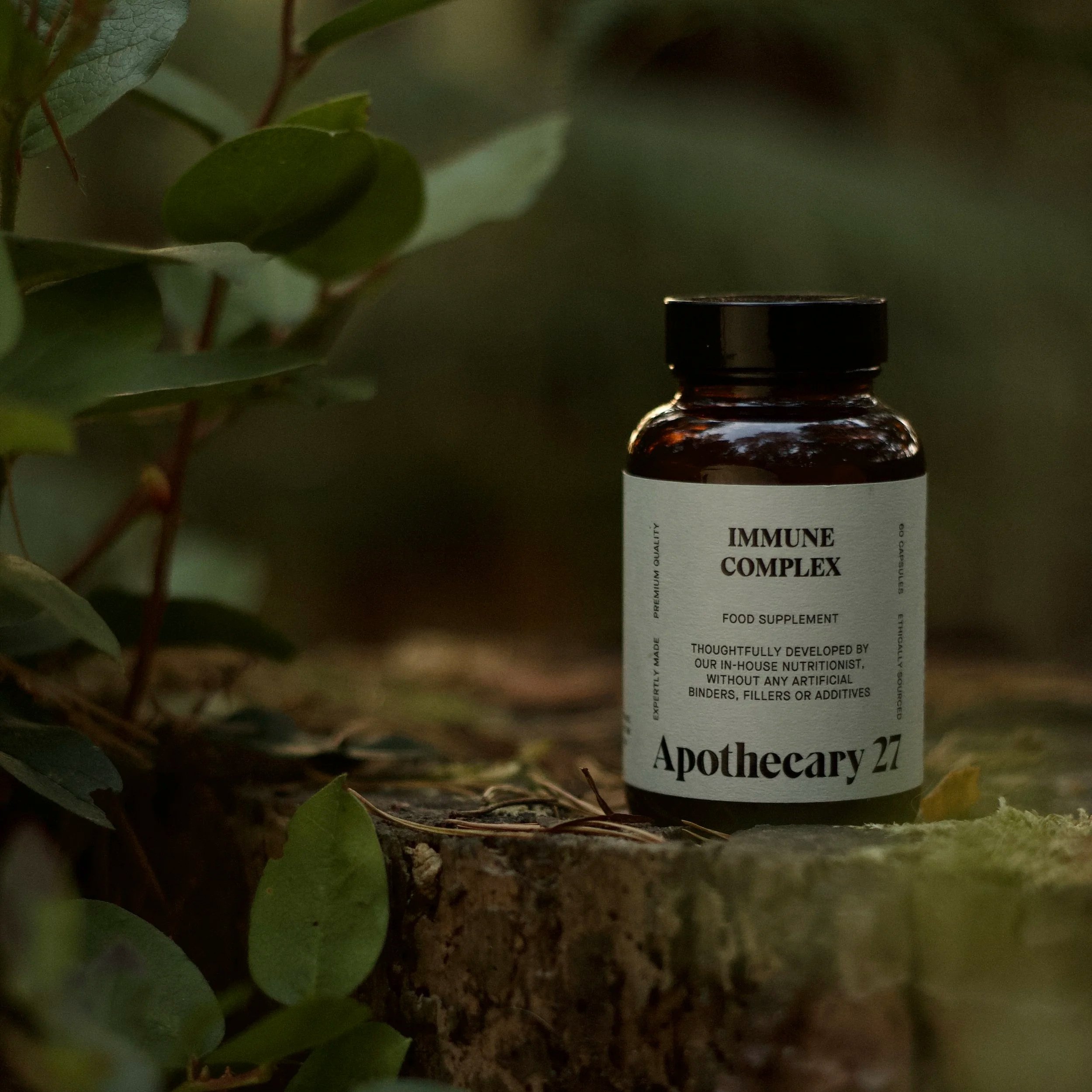
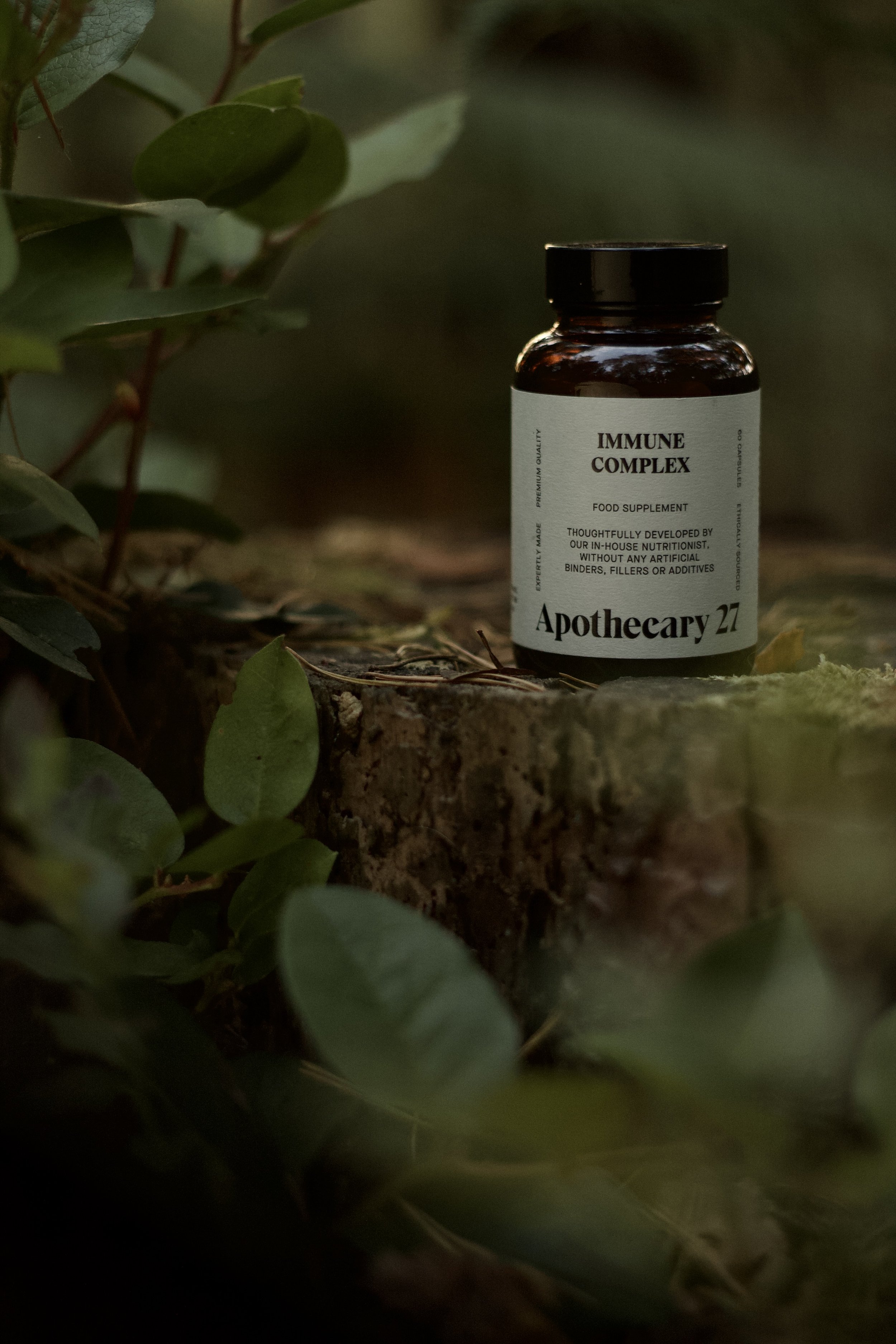
Our winter formula. Eight thoughtfully chosen ingredients, including zinc for normal immune function — each at a dose that matters.
Every year, customers ask for the same thing: one formula they can keep to hand through the colder months. Building our Immune Complex was an exercise in restraint — there are dozens of ingredients we could have used, and most we left out. The eight that made it each earn their place, and each is here at a dose that matters.
At its centre is zinc, as bisglycinate for absorption — an essential mineral that contributes to the normal function of the immune system and the protection of cells from oxidative stress. Around it sit seven of the most time-honoured botanicals in the apothecary tradition: elderberry, rich in the deep-purple anthocyanins it's prized for; garlic and olive leaf, both valued across cultures for thousands of years; andrographis, long used in Ayurvedic tradition; warming ginger; quercetin, a plant flavonoid that pairs naturally with zinc; and a touch of manuka honey — a nod to the kitchen-cupboard remedies that have always sat at the heart of looking after yourself in winter.
It's built to be gentle enough for everyday use through the season, in a clean plant-based capsule with nothing unnecessary added. Made the way everything here is made: meaningful doses, high absorption, always rooted in nature.
DIRECTIONS
Take two capsules daily, with food. For intensive immune support, take two capsules up to three times daily for short periods. Do not exceed the recommended dose unless directed by your healthcare practitioner.
SUPPLEMENT FACTS
Per 2 capsules:
Elderberry Fruit Extract (Sambucus nigra) — 300mg
Garlic Bulb Extract (Allium sativum) — 300mg
Olive Leaf Extract (Olea europaea) — 260mg
Quercetin (Sophora japonica) — 250mg
Andrographis (Andrographis paniculata) — 200mg
Ginger Root Extract (Zingiber officinale) — 40mg
Manuka Honey Powder — 40mg
Zinc (as zinc bisglycinate) — 10mg — 100% NRV
Ingredients: Elderberry Fruit Extract, Garlic Bulb Extract, Olive Leaf Extract, Quercetin, Hydroxypropyl Methylcellulose Capsule (240mg), Andrographis, Ginger Root Extract, Manuka Honey Powder, Zinc Bisglycinate.
60 capsules. No artificial binders, fillers or additives.
QUESTIONS WE GET ASKED
How many should I take?
Two capsules daily through the season. If you feel you need more, two capsules up to three times daily — but keep that to short spells of a few days rather than weeks on end, since it takes the zinc above the level advised for continuous use.
Should I take it all winter, or only when I'm run down?
Either. Two a day is a considered everyday dose from October onwards. Plenty of people keep a bottle in the cupboard and reach for it when they need it instead. Both are sensible.
Why zinc bisglycinate rather than ordinary zinc?
Same reasoning as our magnesium and iron. Bisglycinate is the mineral bound to an amino acid, which makes it well absorbed and easier on the stomach — zinc in particular can be uncomfortable in cheaper forms, especially without food.
Should I take it with anything?
It sits naturally alongside our Liposomal Vitamin C and Vitamin D through the darker months — the three most people ask us about from October onwards.
Is there anyone who shouldn't take it?
Not suitable during pregnancy or breastfeeding. If you take blood-thinning medication, garlic at this level is worth mentioning to your GP or pharmacist first. If you're unsure, ask us in store or book a consultation with Florence.
Is it suitable for vegans?
It contains manuka honey, so it isn't suitable for vegans. It is suitable for vegetarians — the capsule is plant-based.
Food supplements should not be used as a substitute for a varied, balanced diet and a healthy lifestyle. Store in a cool, dry place, out of the reach and sight of children.
THE SEASONAL WELLNESS JOURNAL
OUR GIFT TO YOU WITH EVERY PURCHASE
Dispatches from the apothecary — a seasonal read on health and wellbeing, gathering what we're talking about in store, what's worth knowing this season, and how to live a little better season to season.

Every year it arrives at the same time. The children go back, and within a fortnight the whole town is coughing.

Our customers' favourite — the one that worked for them when others hadn't. Two highly absorbable forms of magnesium, at a meaningful dose.
Magnesium runs through more than 300 processes in the body — energy, muscle function, sleep, mood, how well you handle stress. Many of us don't get as much as we'd like from diet alone — modern soils and modern eating both play a part. The signs are easy to miss and easy to dismiss — restless sleep, tension, flat energy, a shorter fuse — and magnesium plays a role in all of them.
Here's what often goes unsaid: the number on the front of the bottle isn't the amount your body receives. Many use magnesium oxide — inexpensive, high on paper, and poorly absorbed. It reads well, but your body sees far less of it.
Ours is built the other way around. We use citrate and bisglycinate in equal measure — two of the best-absorbed forms there are. Citrate is well-researched and quick to absorb; bisglycinate, magnesium bound to glycine, is exceptionally gentle on digestion and kind to anyone who's found other forms uncomfortable. Together they give you a really meaningful dose your body can recognise and use — not a token gesture.
No binders, no fillers, no artificial anything, in a plant-based capsule. Made the way everything here is made: meaningful doses, high absorption, always rooted in nature.
It's become the most sought-after supplement on our shelves — and once people feel the difference a properly absorbed magnesium makes, they tend to stay with it.
Magnesium contributes to normal muscle function, to the reduction of tiredness and fatigue, to normal psychological function, and to the normal functioning of the nervous system.
DIRECTIONS
Take two capsules daily, with food, or as advised by a healthcare practitioner.
SUPPLEMENT FACTS
Per 2 capsules: Magnesium (from magnesium citrate and magnesium bisglycinate) — 250mg — 66% NRV
Ingredients: Magnesium Citrate, Magnesium Bisglycinate, Capsule Shell (Hydroxypropyl Methylcellulose).
Suitable for vegans. No artificial binders, fillers or additives.
QUESTIONS WE GET ASKED
Citrate or bisglycinate — which is better?
Neither, really. Citrate is well-researched and absorbs quickly; bisglycinate is magnesium bound to glycine and is notably gentle on digestion. We use both in equal measure rather than choosing, so you get the strengths of each.
What's wrong with magnesium oxide?
Nothing, except that very little of it is absorbed. It looks impressive on a label because the elemental number is high, but your body sees a fraction of it. It's cheap, which is why it's everywhere.
When should I take it?
Two capsules daily with food. Many people prefer the evening, some the morning — it's a matter of what suits you. Consistency matters more than timing.
I've found magnesium uncomfortable before. Will this be different?
Quite possibly. Most digestive discomfort comes from poorly absorbed forms, oxide in particular. Bisglycinate is the gentlest of the well-absorbed forms, which is a large part of why it's in here.
Is it suitable for vegans?
Yes. Plant-based capsule, no binders, fillers or artificial anything.
Food supplements should not be used as a substitute for a varied, balanced diet and a healthy lifestyle. Store in a cool, dry place, out of the reach of young children.